
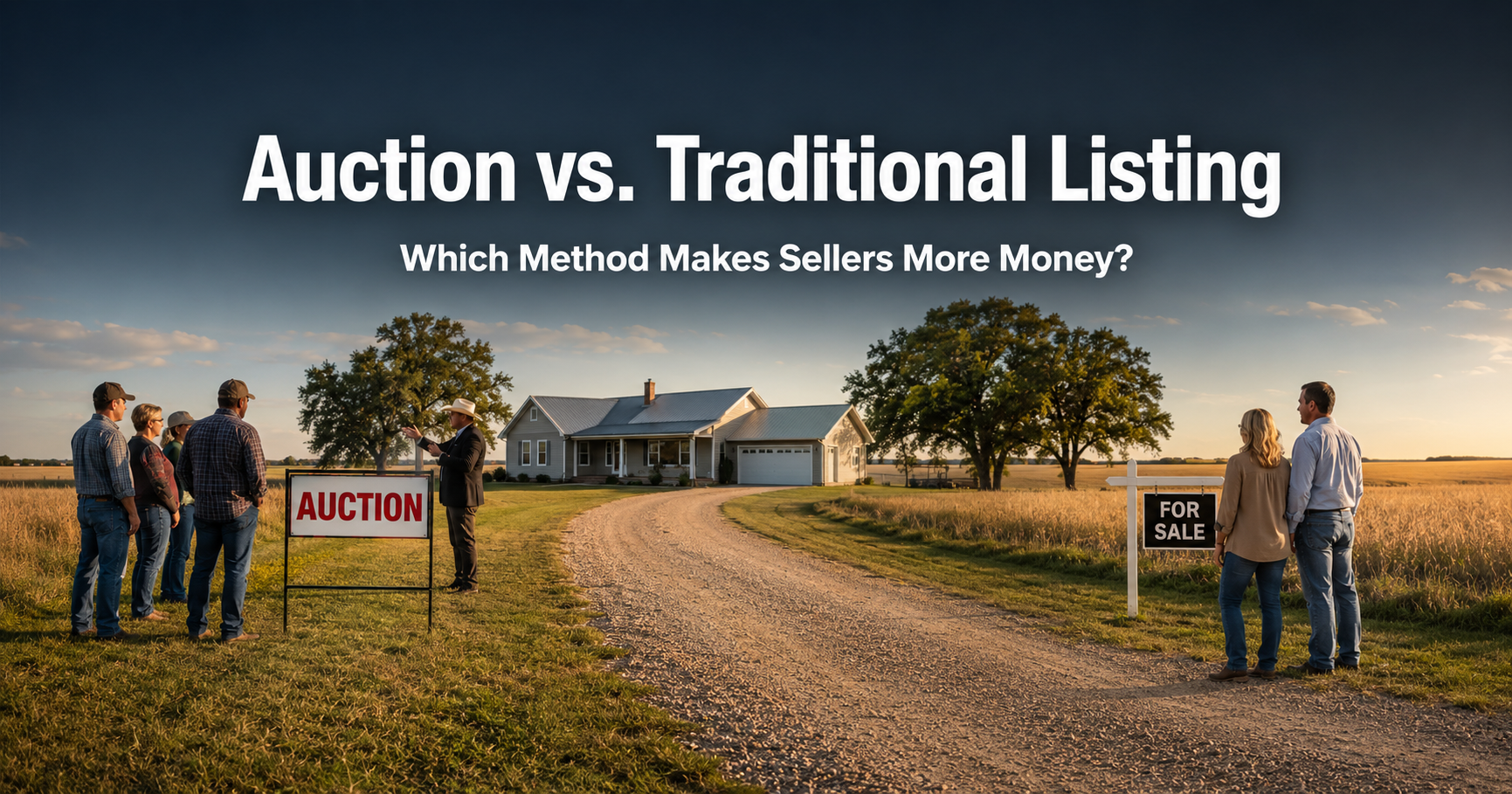
When Kansas property owners begin thinking about a sale, one question usually rises above the rest: Will an auction or a traditional listing put more money in my pocket?
The honest answer is that neither method automatically produces the highest return. An auction can outperform when several motivated buyers are likely to compete, the property is difficult to price, or the seller benefits from a firm timetable. A traditional listing can be the stronger choice when the buyer pool is narrow, the seller needs flexibility, or the property requires a longer negotiation period.
The right comparison is not simply the auction bid versus the listing price. Sellers should compare probable net proceeds, time on market, carrying costs, inspection and financing risk, negotiation leverage, and the chance that a buyer will actually close.
Bottom line: An auction often has the best opportunity to exceed expectations when a property can attract multiple qualified bidders. A traditional listing may make more when the property needs a specific buyer, additional marketing time, or negotiated terms.
What Does 'More Money' Really Mean?
A high headline price does not always create the best result. Sellers ultimately keep the net amount remaining after expenses, credits, carrying costs, and any price reductions or post-contract concessions.
A useful way to evaluate each method is:
Net proceeds = sale price − seller expenses − concessions − carrying costs − unresolved closing risk
Commission and fee structures vary and are negotiable. Some auctions use a buyer's premium, some use a seller-paid fee, and some use a combination. Traditional listings also vary. Every seller should request a written net sheet so the comparison is based on the complete transaction rather than one percentage or one advertised price.
Auction vs. Traditional Listing at a Glance
| Decision factor | Real estate auction | Traditional listing |
|---|---|---|
| Price discovery | Competitive bidding reveals what qualified buyers will pay on a defined day. | Seller sets an asking price and evaluates offers over time. |
| Timeline | A scheduled marketing period, auction date, and defined closing expectations. | Timing is flexible, but days on market and closing dates are less predictable. |
| Negotiation | Terms are generally established before bidding; buyers compete under the same rules. | Price, inspections, repairs, financing, possession, and closing can be negotiated. |
| Best buyer environment | Several buyers have a reason to compete for the same property. | The likely buyer pool is small or needs additional time and flexibility. |
| Seller risk | A reserve auction can protect a minimum acceptable result; exact terms vary. | An accepted offer may still include financing, appraisal, inspection, or sale-of-home conditions. |
When an Auction May Produce More Money
An auction is strongest when competition is the pricing strategy. Instead of placing a ceiling on the property with an asking price, the seller invites qualified buyers to compete until only the highest bidder remains.
- The property has several logical buyers. Neighbors, expanding operators, investors, recreational buyers, or local residents may all value the property differently.
- The property is hard to price. Unique farmland, hunting ground, rural homes, estates, and mixed-use tracts may have few truly comparable sales. Bidding can expose demand that an asking price misses.
- The seller needs a definite timetable. A scheduled auction creates urgency and concentrates buyer decisions within a defined marketing window.
- The property can be offered in tracts. Multi-parcel bidding may reveal whether the whole property or a combination of smaller tracts creates the most value.
- The terms matter as much as the price. Auction terms can be established in advance, often reducing repeated negotiations over repairs, contingencies, and possession.
Auctions are especially effective for Kansas farmland because nearby operators may value adjacency, investors may value income, and recreational buyers may value habitat. When they meet in a competitive process, the seller may benefit from their different motivations.
When a Traditional Listing May Produce More Money
A traditional listing gives the seller more time to locate a particular buyer and negotiate an individual package of price and terms. That flexibility can be valuable in the right situation.
- The likely buyer pool is limited. A specialized commercial site, unusual improvement, or high-priced rural residence may need one specific buyer rather than a crowd of bidders.
- The seller is not working against a deadline. If carrying costs are manageable, the owner may be comfortable waiting for a stronger offer.
- Buyer financing is central to the sale. Some buyers need extended financing, appraisal, inspection, or home-sale contingencies that may fit more naturally in a negotiated listing.
- The property needs time or preparation. Repairs, clean-up, surveys, access questions, tenant arrangements, or title matters may need to be resolved before the market can respond confidently.
- The seller wants maximum flexibility. A listing allows the owner to consider different possession dates, personal-property arrangements, improvements, and other negotiated details.
The Hidden Costs That Can Change the Answer
A traditional listing that sells for slightly more can still net less if the property sits for months. Taxes, insurance, utilities, mowing, maintenance, interest, lost rent, and the owner's time all reduce the benefit of waiting. Price reductions can also signal weakness and encourage buyers to negotiate harder.
An auction has its own costs and risks. Marketing must be strong enough to reach the right buyers, due-diligence materials must be ready, and the auction date creates a real decision point. If exposure is weak or bidders are not confident in the property information, competition may never fully develop.
Closing risk also matters. A higher contingent offer is not automatically better than a slightly lower offer with clean terms and a high probability of closing.
How to Choose the Best Method for Your Property
Before deciding, ask a land and auction professional to answer five questions:
- What is the property's realistic value range? Start with local comparable sales, income, soil productivity, water, improvements, access, and recreational value.
- Who are the most likely buyers? Identify neighbors, operators, investors, hunters, rural-home buyers, developers, and out-of-area prospects.
- Will at least two or three qualified buyers compete? Competition is the engine that gives an auction its greatest upside.
- What is the cost of waiting? Estimate carrying expenses, lost income, maintenance, and the personal cost of an uncertain timeline.
- Which terms protect the seller's goals? Compare contingencies, inspections, earnest money, closing timeline, possession, reserve options, and expected net proceeds.
Frequently Asked Questions
Do auctions always sell property for more?
No. Auctions create an opportunity for competitive bidding, but the result depends on the property, buyer demand, marketing, terms, due diligence, and bidder confidence.
Does a traditional listing put a ceiling on the price?
An asking price can anchor buyer expectations, but multiple offers can still push a listed property above asking. The important question is whether the pricing and marketing strategy encourages enough qualified buyers to act.
Can a seller protect a minimum price at auction?
Yes, a reserve auction can generally be structured so the property sells only if the bidding meets the seller's approved minimum, subject to the written auction agreement and announced terms.
Are auction properties always distressed?
No. Auctions are used for productive farmland, ranches, hunting land, rural homes, estates, commercial property, and conventional residences. Sellers often choose an auction for competition, a definite timetable, and clear terms—not because they are in distress.
Which Method Is Right for Your Kansas Property?
The best sale method is the one designed around your property and your goals. Productive farm ground with several likely bidders may be an excellent auction candidate. A rural home needing a particular buyer and flexible financing may perform better as a traditional listing.
Contact Alex Miller to discuss your Kansas farm, ranch, hunting property, home on acreage, estate property, or other real estate. You will receive a straightforward recommendation based on the property—not a one-size-fits-all sales pitch.
Alex Miller | L2 Realty Inc. & Auction | 316-313-4759