
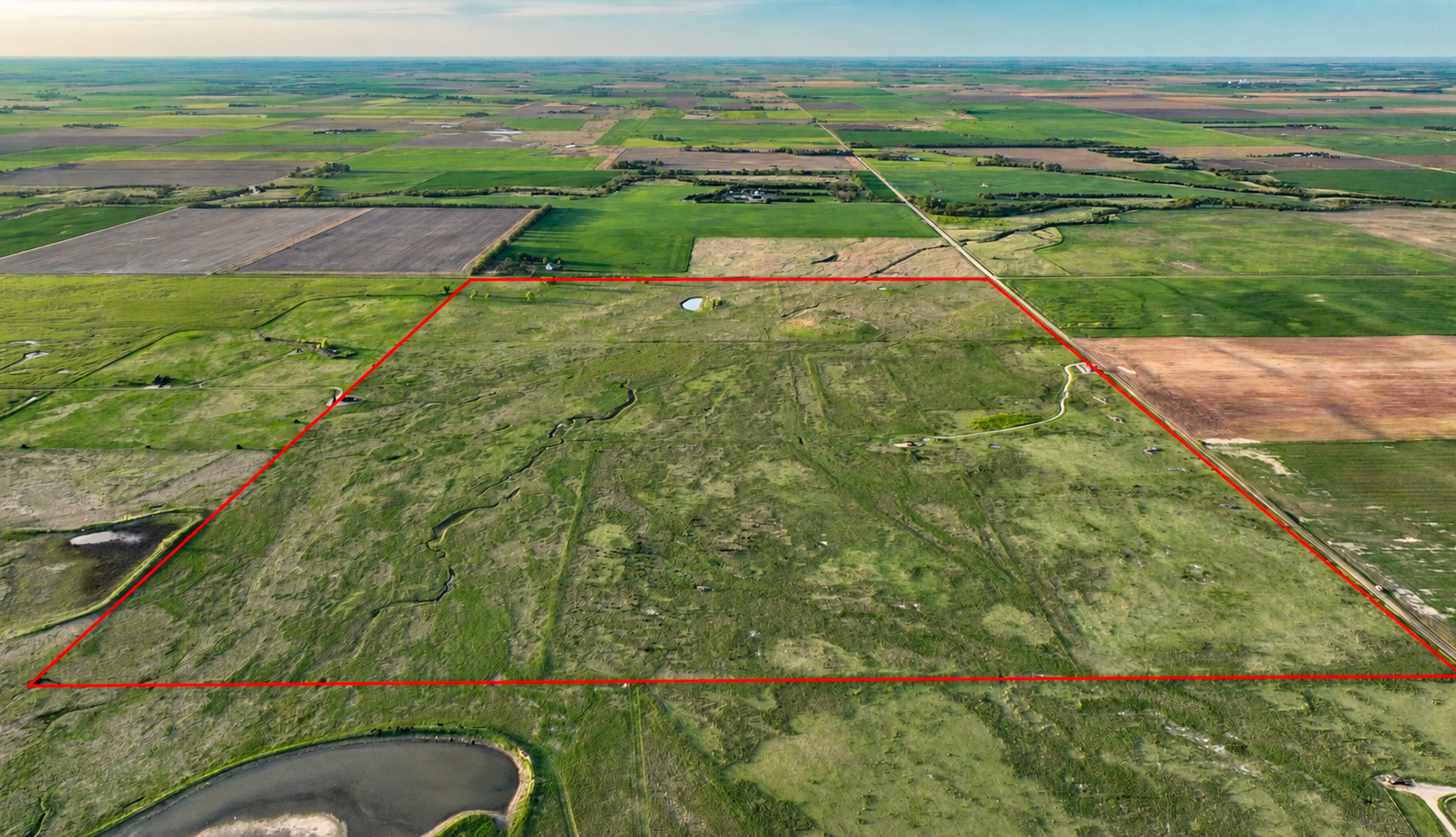
Kansas farm ground does not have one universal price per acre. Two tracts in the same county can sell for very different amounts because buyers are not purchasing acreage alone. They are purchasing productive capacity, access, water, improvements, income, location, future options, and the level of confidence created by good records and clear sale terms.
The short answer is that value comes from the combination of what the land can produce, what it costs to own and operate, how it compares with recent local sales, and how strongly qualified buyers compete for it. A statewide or county average can provide context, but a property-specific analysis is what turns that context into a defensible value range.
The Main Factors at a Glance
| Factor | What buyers examine | Why it affects value |
|---|---|---|
| Productivity | Soils, slope, drainage and yield history | Shapes long-term earning potential |
| Water | Rights, wells, ponds and reliability | Supports crops, livestock and recreation |
| Income | Cash rent, crop-share returns and expenses | Connects ownership to investment return |
| Location | Local operators, roads, markets and towns | Changes demand, costs and alternative uses |
| Tract utility | Size, shape, access and tillable percentage | Affects farming efficiency and buyer pool |
| Improvements | Fences, terraces, bins, buildings and irrigation | Can add utility but also future expense |
| Market timing | Recent sales, interest rates and buyer confidence | Sets the environment in which bids are made |
| Sale execution | Records, marketing, terms and competition | Determines how clearly the market sees the value |
1 Soil Quality and Productive Capacity
Soil is one of the first places to look when valuing Kansas cropland. Buyers compare soil types, available water capacity, slope, erosion risk, drainage, and expected productivity. A tract with deep, efficient soils and a high percentage of tillable acres often attracts stronger interest than one with irregular fields, steeper slopes, wet spots, or large nonproductive areas.
The National Commodity Crop Productivity Index, often called NCCPI, can help summarize soil productivity, but it should not be treated as a sale-price formula. Buyers also consider actual yield history, conservation practices, field condition, and how the soils perform under local weather patterns. USDA NRCS Web Soil Survey is a useful starting point, while FSA maps and farm records help connect mapped soils to real-world use.
For pasture, the questions change. Forage capacity, native versus tame grass, brush pressure, water distribution, cross-fencing, and realistic stocking rates can matter more than a cropland index.
2 Water and Irrigation
Reliable water can be one of the largest value drivers in Kansas, but the details matter. Irrigated ground may command a premium when the water right is usable, the well is dependable, and the equipment is serviceable. Buyers will want to understand authorized quantity, historical use, well capacity, energy source, pumping costs, and the age and condition of pivots or other irrigation equipment.
A label such as "irrigated" does not guarantee a premium. Limited or declining water, regulatory constraints, high operating costs, or equipment nearing replacement can narrow the difference from dryland. On pasture and recreational property, ponds, creeks, springs, rural water, and dependable livestock water can materially influence use and demand.
3 Income and Lease Terms
Farm ground is often evaluated as an income-producing asset. Buyers may compare expected rent or owner-operator returns with the purchase price, property taxes, financing costs, and risk. Strong, repeatable income can support value; unusually favorable income from one year may not.
The existing lease can also affect a sale. Buyers need to know whether the farm is cash rented or crop shared, when the lease ends, who has possession, and whether payments or expenses have been prorated. A clear written lease can reduce uncertainty. An unclear tenancy, unusually low rent, or delayed possession may reduce immediate utility for some buyers even when the underlying land is good.
4 Location and the Local Buyer Pool
Land values are local. A farm next to several established operators may draw expansion buyers who can create operational efficiencies. Ground near a strong agricultural community, grain elevator, feedyard, paved road, or equipment base can have practical advantages. Proximity to Hutchinson, Wichita, or another growth area may introduce acreage, development, or investment demand that is not captured by agricultural income alone.
Location can also work against a property. Long hauling distances, weak road access, railroad or highway complications, flooding, or isolation from likely operators can reduce demand. This is why a sale from another part of the county may be a poor comparable even when the acreage and land class appear similar.
5 Size, Shape, Access, and Tillable Percentage
Buyers pay attention to how a tract works, not just how many acres it contains. Square or rectangular fields with good road frontage are typically easier to farm than narrow, divided, or irregular fields. The ratio of tillable acres to total acres can be especially important when comparing per-acre sales.
Legal and physical access should be confirmed before marketing. A visible trail or long-used driveway is not always the same as a recorded right of access. Gates, low-water crossings, bridges, section-line roads, and seasonal conditions should be explained. Clear access broadens the buyer pool and gives lenders and appraisers more confidence.
6 Improvements and Deferred Maintenance
Useful improvements can add value, but buyers rarely credit every dollar originally spent. Fencing, corrals, terraces, waterways, drainage work, grain storage, sheds, homes, and irrigation systems are judged by remaining useful life and contribution to the property. A building with limited agricultural use may contribute less than its replacement cost, while a dependable livestock water system or well-designed set of corrals may be highly valuable to the right buyer.
Deferred maintenance works in the other direction. Poor fences, sediment-filled ponds, failing terraces, unsafe structures, uncontrolled trees, and worn irrigation equipment can create an immediate capital burden. Documenting repair history and service records helps buyers distinguish a functioning asset from an unknown expense.
7 Recreation, Minerals, and Other Rights
Some Kansas farms have value beyond crop or grazing income. Timber, river or creek frontage, wetlands, secluded bedding cover, food plots, ponds, and proven wildlife travel corridors can attract hunting and recreational buyers. The premium depends on habitat quality, privacy, access, neighboring land use, and the scarcity of similar properties -- not simply the presence of deer sign.
Mineral rights, wind or solar agreements, conservation easements, CRP contracts, hunting leases, and other encumbrances can also affect value. Their impact may be positive, negative, or mixed depending on the income, restrictions, duration, transferability, and buyer's goals. Sellers should identify what transfers with the land and have the relevant documents ready for review.
8 Comparable Sales and Current Market Conditions
Recent arms-length sales remain one of the best indicators of what informed buyers have paid for similar property. The challenge is finding sales that are truly comparable. Adjustments may be needed for location, sale date, soils, water, improvements, tract size, tillable percentage, lease status, minerals, and sale conditions.
Market conditions also change the result. Interest rates influence purchasing power and required investment returns. Commodity prices, cattle profitability, local cash rents, farm income, lender appetite, tax planning, and the amount of land available at one time all shape demand. A sale from several years ago should not be carried forward without considering what changed.
9 Highest and Best Use
Most Kansas farm ground is valued primarily for agriculture, but some tracts have a different or blended highest and best use. A smaller parcel near a town may appeal as a home site. Land with strong habitat may draw recreational buyers. Highway frontage or proximity to utilities may create commercial or development potential. These possibilities should be realistic, legally permissible, physically possible, and financially supported -- not based on speculation alone.
10 Marketing, Sale Terms, and Competition
A property's physical characteristics establish its potential value, but the sale process affects whether the market recognizes that value. Complete maps, aerial imagery, soil information, leases, FSA records, improvement details, title work, and clear terms reduce unanswered questions. Professional photography and targeted advertising help reach local operators, investors, neighbors, recreational buyers, and out-of-area prospects who fit the property.
The choice between auction and traditional listing should be based on the property and seller's goals. An auction can be effective when multiple buyers are likely to compete and the seller wants a defined timetable and consistent terms. A traditional listing may fit a specialized property that needs a longer negotiation period. The meaningful comparison is expected net proceeds, timing, certainty, and risk -- not the asking price alone.
How Professionals Estimate Farm Value
A sound opinion of value usually considers more than one method:
- Sales comparison approach: analyzes recent sales and adjusts for meaningful differences between the sold farms and the subject property.
- Income approach: estimates the income a typical owner could receive, subtracts appropriate expenses, and relates net income to the return buyers require.
- Cost or contributory-value analysis: considers the value added by useful improvements, less age, condition, and obsolescence.
A broker price opinion or comparative market analysis can help a seller plan a sale. A certified appraisal may be appropriate for estates, lending, litigation, gifts, tax matters, or other situations requiring a formal independent opinion. The purpose of the valuation should determine the professional and report needed.
Tax Value Is Not the Same as Market Value
Kansas agricultural land is generally valued for property-tax purposes according to agricultural use and productivity. That assessed use value is not an estimate of what the farm would sell for on the open market. Sellers should not use the county tax figure as their asking price or expected auction result.
A Practical Pre-Sale Value Checklist
- Confirm total acres, legal description, boundaries, and legal access.
- Gather FSA maps, crop history, yield records, soil information, and conservation records.
- Document water rights, well performance, irrigation equipment, ponds, and rural water.
- Review leases, possession dates, rent, CRP obligations, and hunting agreements.
- List improvements with age, condition, recent repairs, and utilities.
- Identify mineral interests, easements, wind or solar agreements, and other restrictions.
- Study recent local sales and current competition -- not just county or statewide averages.
- Compare auction and traditional listing based on likely net proceeds and the seller's timeline.
Frequently Asked Questions
What is the most important factor in Kansas farm value?
There is no single factor for every farm. Productive capacity and local comparable sales usually carry substantial weight, but water, location, access, income, improvements, and buyer competition can change the result.
Does better soil always mean a higher sale price?
Better soil often supports stronger income and value, but buyers evaluate the complete tract. A farm with excellent soils can still be discounted for poor access, drainage problems, an unfavorable lease, or inefficient field shape.
How much value does irrigation add?
The premium depends on the water right, dependable capacity, equipment condition, energy cost, crop economics, and local demand. Irrigation should be analyzed as a working system rather than a simple label.
Do buildings increase a farm's value dollar for dollar?
Usually not. Buyers consider each improvement's usefulness, condition, remaining life, and fit with the property. Specialized or obsolete structures may contribute little to a buyer who cannot use them.
Can hunting features increase farmland value?
Yes, when habitat, water, timber, privacy, access, and local wildlife quality attract recreational buyers. The agricultural and recreational components should be evaluated together without double counting the same acres.
Should I get an appraisal before selling?
It depends on the purpose. A market analysis may be enough for sale planning, while an estate, lender, court, tax matter, or ownership dispute may call for a certified appraisal and advice from legal or tax professionals.
What Is Your Kansas Farm Ground Worth?
A reliable value range begins with the farm itself: its soils, income, water, access, improvements, rights, location, and likely buyer pool. The next step is to compare those facts with current local sales and choose a sale strategy that presents the property clearly and creates the best opportunity for qualified buyers to act.
I help Kansas landowners evaluate farm ground, pasture, hunting property, ranches, homes on acreage, and other rural real estate. If you are considering a sale, I can review the property, study comparable sales, identify likely buyers, and compare auction and traditional-listing options.
Alex Miller | L2 Realty Inc. & Auction | 316-313-4759
About the Author
Alex Miller is a full-time Kansas auctioneer and real estate agent with L2 Realty Inc. & Auction. Raised on a farm near Arlington, Kansas, he works with farm and ranch land, recreational property, homes on acreage, and real estate auctions across the state. Alex is the 2026 Kansas Auctioneers Association Champion Auctioneer and serves on the Kansas Auctioneers Association Board of Directors.
Sources and Important Note
- K-State Research and Extension AgManager -- Land Buying and Valuing
- USDA Natural Resources Conservation Service -- Web Soil Survey
- USDA Farm Service Agency -- Farm records and acreage maps
- Kansas Department of Revenue -- Agricultural Use Valuation
This article provides general market information and is not a certified appraisal, legal opinion, tax advice, survey, or guarantee of sale price. Property-specific decisions should be based on current information and advice from the appropriate qualified professionals.