
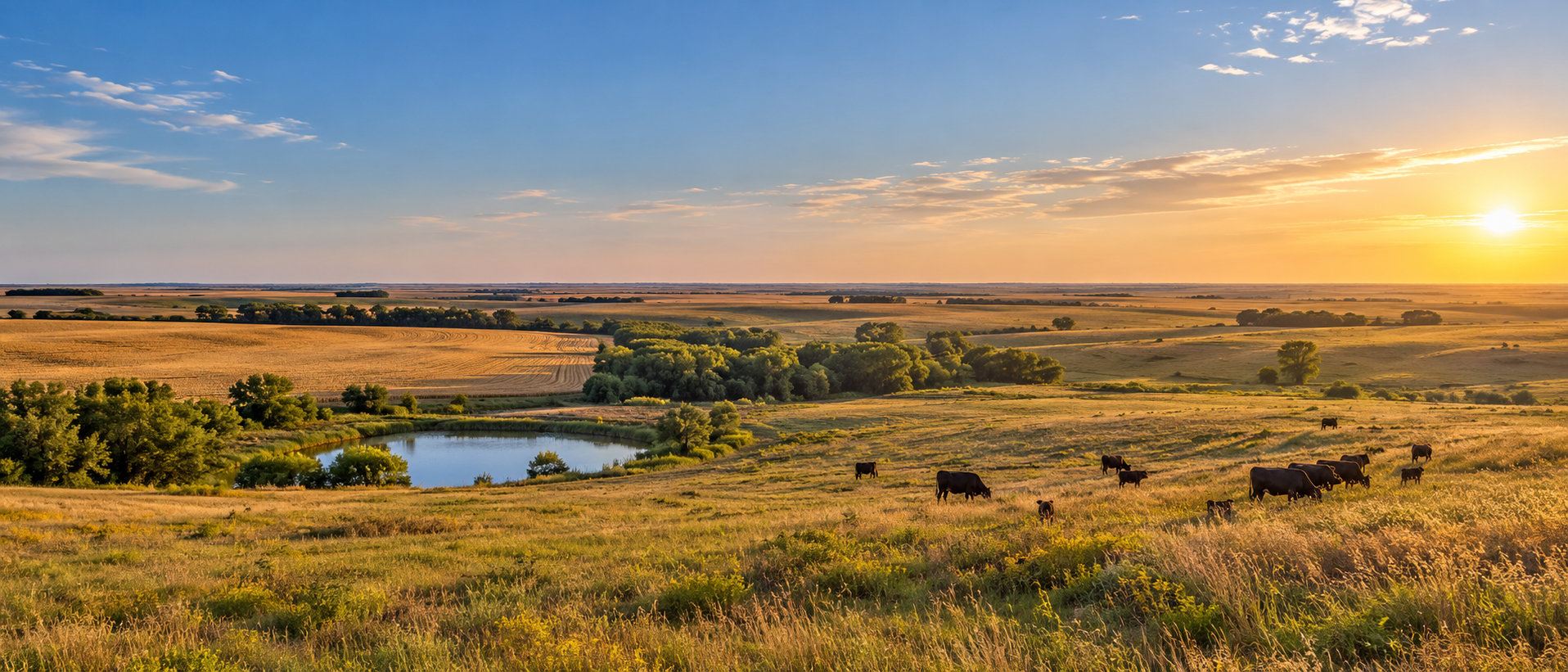
Kansas agricultural land remained a resilient asset through August 2026, but the market was not moving evenly. Pasture and ranchland continued to show the strongest momentum. Cropland values stayed supported, yet tighter crop margins, drought expansion, and careful lender underwriting caused buyers to study each property more closely.
The most important August takeaway is not that every acre increased by the same percentage. It is that quality, operating fit, and certainty mattered more. Productive soils, dependable water, usable fencing, efficient fields, clear leases, and complete records helped buyers justify their bids. Farms with unresolved access, title, water, possession, or condition questions faced a more selective audience.
August market snapshot: USDA valued Kansas cropland at an average of $3,540 per acre in 2026, including $4,600 for irrigated and $3,450 for non-irrigated ground. Pasture averaged $2,400 and posted the strongest statewide annual gain. In the Tenth Federal Reserve District, ranchland values grew more than 7% from a year earlier while cropland gains were more moderate.
Kansas Land Value Benchmarks Available in August
USDA released its annual Land Values Summary on July 31, making those figures the principal statewide benchmark available during August. The estimates describe broad Kansas averages as of the 2026 survey period; they do not measure a one-month August price change and should not be treated as a price for a specific farm.
| Kansas land category | 2026 average | 2025 average | Annual change |
|---|---|---|---|
| Farm real estate | $3,200/acre | $3,100/acre | +3.2% |
| All cropland | $3,540/acre | $3,440/acre | +2.9% |
| Irrigated cropland | $4,600/acre | $4,500/acre | +2.2% |
| Non-irrigated cropland | $3,450/acre | $3,350/acre | +3.0% |
| Pastureland | $2,400/acre | $2,270/acre | +5.7% |
Source: USDA NASS, Land Values 2026 Summary, released July 31, 2026. Farm real estate includes land and buildings on farms. Statewide estimates provide direction and context, not a property-specific appraisal.
What Changed in the August Market Conversation
Pasture and Ranchland Kept the Strongest Momentum
August evidence continued to favor grass and ranch assets. Kansas pasture showed the largest year-over-year increase in USDA's state estimates. The Kansas City Fed's second-quarter lender survey, released August 14, reported that ranchland values across the Tenth District grew more than 7% from a year earlier, compared with about 1% for non-irrigated cropland and 4% for irrigated cropland.
The same survey tied part of that strength to the cattle side of the agricultural economy. Record cattle prices supported incomes in livestock-heavy areas even while the crop sector remained under pressure. Buyers still distinguished between grass acres. Dependable livestock water, functional fences, usable handling facilities, access, forage condition, and realistic stocking capacity determined whether a property captured the broader ranchland strength.
Cropland Remained Firm but Buyers Became More Selective
Kansas cropland did not show a broad collapse. USDA's annual averages were higher than 2025, and the Kansas City Fed reported continued regional gains. However, August buyers had reasons to be disciplined. Crop profit opportunities remained narrow, operating costs stayed elevated, and weather risk increased across portions of Kansas.
In that environment, a farm's income story had to be credible. Buyers compared soil productivity, actual yields, cash rent, irrigated versus dryland use, drainage, field shape, tillable percentage, lease terms, and deferred maintenance. A high-quality tract next to an established operator could still attract aggressive bidding. A farm priced from a statewide average without accounting for local limitations was more likely to meet resistance.
Drought Returned to the Center of the Analysis
Dryness expanded during August across the Southern Plains. U.S. Drought Monitor data for August 25 showed roughly 46% of Kansas in moderate drought or worse and about 70% at least abnormally dry. Federal climate officials also identified a rapid-onset drought risk affecting parts of Kansas and neighboring states in mid-August.
Drought can affect land value through several channels: current crop income, forage production, pond and stream reliability, irrigation demand, well performance, and the amount of working capital a buyer is willing to commit. One dry month does not automatically reduce long-term value, but it can change how buyers price risk. Farms with strong soils, proven water, drought-resilient grass, or documented production history may stand out more when conditions turn dry. For a deeper look at how soil and water quality shape long-term value, see Understanding Soil Productivity and Land Value.
Crop Results Added Pressure to Farm Income
USDA's August production outlook reflected a difficult Kansas wheat year. The August forecast placed the Kansas winter wheat crop near 191 million bushels, roughly 45% below the previous year. Corn, soybean, and sorghum prospects varied widely by location as late-summer moisture became increasingly important.
Weak production does not translate directly into lower sale prices. Many land purchases are made with long holding periods, significant equity, tax considerations, expansion goals, and strategic value to neighboring operators. It does, however, affect cash flow, rent negotiations, lender conversations, and the price discipline of highly leveraged buyers.
Credit Tightened Gradually While Land Values Held
The Kansas City Fed reported that farm income and credit conditions continued to deteriorate gradually in the second quarter, although overall financial stress remained modest. Less than 10% of surveyed farm-loan balances had major or severe repayment problems. Repayment concerns were slightly more pronounced in Kansas and Nebraska, but strong land values and government support helped farm balance sheets remain resilient.
Farm-loan interest rates were nearly unchanged from the prior quarter. They were approximately 50 basis points below the same time in 2025 and 120 basis points below 2024, yet still slightly above the average of the prior two decades. That offered some relief without making financing inexpensive. Cash buyers and well-capitalized operators retained an advantage, especially when auction terms required quick decisions and limited contingencies.
August Signals at a Glance
| Market signal | August evidence | Likely effect on buyers and sellers |
|---|---|---|
| Cropland values | Still positive but slower than the rapid-gain years | Quality and income support value; aggressive pricing receives more scrutiny |
| Pasture and ranchland | Strongest appreciation and continued cattle support | Good water, fences, forage, access, and facilities can widen the buyer pool |
| Cash rents | Fed lenders reported crop rents down about 2% and ranch rents up about 6% year over year | Buyers test income assumptions instead of capitalizing an unusually strong rent |
| Drought | Dryness expanded across Kansas late in August | Water, soil depth, forage resilience, and production history matter more |
| Credit | Gradual tightening with modest stress | Terms, equity, lender readiness, and closing certainty influence competition |
| Inventory | Local and uneven | A scarce, well-located tract can outperform broad averages |
What August Meant for Kansas Sellers
Price from current local evidence. Use recent nearby sales, land type, soils, water, income, access, improvements, and likely buyer demand — not a statewide average alone.
Lead with the strongest verified facts. Buyers want FSA records, soil maps, leases, possession dates, water information, taxes, title work, boundaries, access, and improvement details. See Preparing Your Farm for Sale: A Complete Seller Checklist for a full pre-sale review.
Explain weather exposure honestly. Document irrigation capacity, ponds, wells, conservation work, drainage, and production history without promising future yields.
Market to every logical buyer group. Neighbors, local operators, investors, cattle producers, recreational buyers, and acreage prospects value different features.
Choose the sale method for the property. Auction can work well when multiple qualified buyers have a reason to compete and the seller wants defined terms and timing. A traditional listing may fit a specialized property needing extended negotiation. Learn more about how real estate auctions work in Kansas.
Compare net proceeds and certainty. Consider carrying costs, concessions, contingencies, marketing, buyer's-premium structure, closing risk, and timing — not only the headline price.
What August Meant for Kansas Buyers
Do not assume tighter crop economics will create a statewide land-price decline. Quality tracts and adjoining acres can remain intensely competitive.
Stress-test income. Use realistic yields, rent, expenses, interest rates, irrigation costs, taxes, and improvement needs.
Study water and drought resilience. Confirm water rights, well capacity, pond reliability, forage condition, soil water-holding characteristics, and any known restrictions.
Read the sale terms before setting the maximum bid. Possession, crop rights, leases, minerals, earnest money, closing date, and contingencies can change the economics.
Separate strategic value from investment return. Adjoining land may reduce travel, improve access, enlarge a field, or protect a boundary, creating value beyond cash rent. Kansas farmland values by region provide useful context for evaluating specific tracts.
Outlook Entering the Fall 2026 Selling Season
The evidence available at the end of August pointed to a stable but increasingly segmented fall market. Kansas City Fed lenders expected cropland values to remain generally steady over the following three months and anticipated further support for ranchland. The strongest properties were likely to remain well bid, particularly when they offered clear title, useful access, good soils or grass, dependable water, and a logical fit for nearby buyers.
The largest risks were not a single statewide price movement. They were property-specific: unrealistic seller expectations, weak documentation, unresolved leases or access, questionable water assumptions, deferred improvements, and marketing that failed to reach the most motivated buyers. Fall harvest results, cattle prices, interest rates, local inventory, and weather would continue shaping the market county by county.
Bottom line: Kansas land remained resilient through August 2026. Pasture and ranchland led the market, cropland held firm at a slower pace, and drought plus narrow crop margins increased buyer selectivity. A local property analysis remained far more useful than a statewide average by itself.
Frequently Asked Questions
Did Kansas farmland prices fall in August 2026?
The available evidence did not show a broad statewide collapse. USDA annual values were higher than 2025, and the Kansas City Fed reported continued regional appreciation. Individual sales still varied widely by location, quality, terms, and buyer competition.
What type of Kansas land was strongest?
Pasture and ranchland showed the strongest momentum. Kansas pasture posted the largest statewide annual gain, and Tenth District ranchland values increased more than 7% year over year in the second quarter.
Did drought lower Kansas land values?
Drought increased scrutiny of water, soils, forage, yields, and income, but one season does not determine long-term value. The effect depends on the property, buyer type, financing, and whether the drought exposes a lasting limitation or a temporary income setback.
Is the USDA average what my farm should sell for?
No. Statewide averages provide direction. A specific farm must be compared with current local sales and adjusted for soils, water, use, tillable percentage, access, improvements, leases, recreation, development potential, terms, and the likely buyer pool.
Should a Kansas landowner sell in the fall?
Fall can be effective when buyers understand their harvest results, operators can plan for the next crop year, and the property package is ready. The best timing depends on title, lease and possession dates, property appearance, buyer availability, and the seller's goals.
Get a Property Specific Kansas Land Review
Monthly reports reveal direction, but they do not establish the value of an individual farm. I help Kansas landowners evaluate farm ground, pasture, ranches, hunting property, homes on acreage, and estate farms, then compare auction and traditional-listing strategies based on the property and the seller's priorities.
Alex Miller | L2 Realty Inc. & Auction | 316-313-4759
Sources: USDA NASS Land Values 2026 Summary; Federal Reserve Bank of Kansas City Q2 2026 Agricultural Credit Survey; USDA NASS August 2026 Crop Production; U.S. Drought Monitor; K-State AgManager Land Buying and Valuing. This report provides general market information, not an appraisal, investment recommendation, legal opinion, tax opinion, or guarantee of a sale result. USDA figures are survey estimates; Federal Reserve findings summarize lender responses across the Tenth District; drought and crop estimates describe conditions available at the stated time and may later be revised.